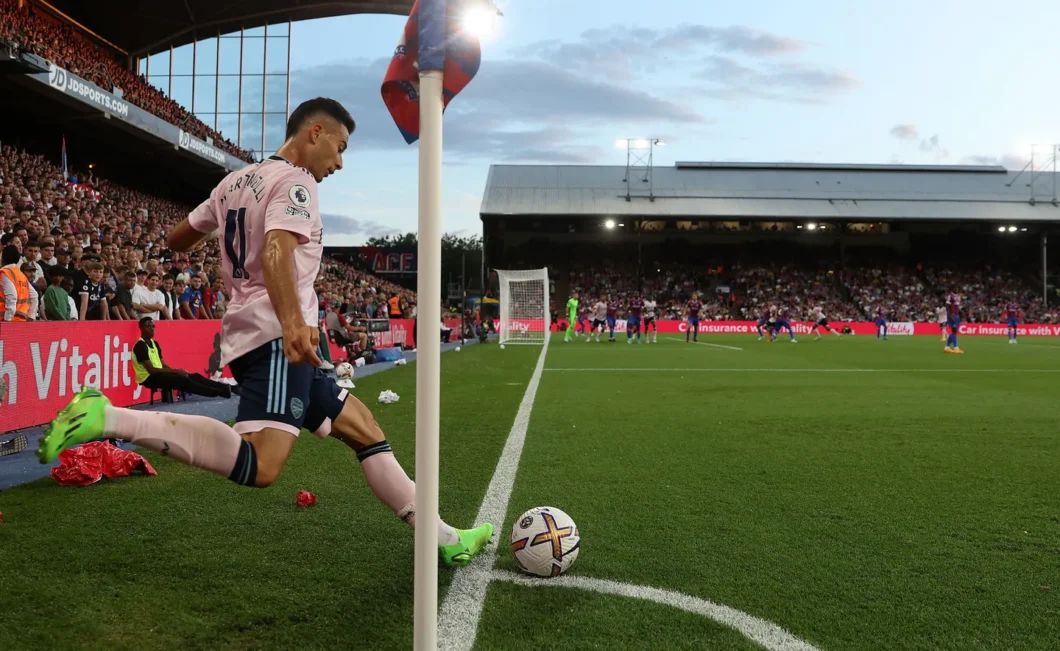
In a game increasingly shaped by data, control and stoppages, the dead ball has become the perfect symbol of modern football. There was a time when set pieces felt like football’s afterthoughts. Useful, yes. Necessary, at times. But still secondary to the real business of the game: the passing moves, the dribbles, the little flashes of invention that made football feel alive. A corner was a chance. A free-kick was an opportunity. A throw-in, in most cases, was simply a way of getting on with things. Now, though, those moments have drifted closer to the centre. Set pieces are no longer the punctuation marks of a match. Increasingly, they are part of the grammar. And while their rise has been widely noted, what they really reveal is something larger: a sport becoming more optimised, more interrupted and, in subtle but unmistakable ways, less spontaneous than before.
That does not mean football has become all about set pieces. Far from it. In fact, that is one of the first myths worth getting out of the way. The modern game has not become a non-stop dead-ball carnival in which every match is decided by corners and long throws raining into the box. The truth is more interesting, and slightly more troubling. Set-piece goals have increased, certainly, but total goals in the Premier League have not risen with them. Quite the opposite. There have been fewer goals than in recent seasons, because the growth in dead-ball scoring has been outweighed by a sharper decline in goals from open play. In other words, set pieces are not adding to football’s richness so much as compensating for what has ebbed elsewhere.
More dead-ball goals, fewer goals overall
That point matters because it changes the tone of the discussion. If set pieces were rising in a game that remained otherwise expansive and free-flowing, they might simply look like a welcome tactical innovation — another route to goal, another layer of complexity. But that is not quite the landscape now. The increase in dead-ball efficiency has arrived alongside a broader contraction. Fewer shots. Fewer passes. Less time with the ball actually in play. More interruption, more management, more moments in which the game seems to pause, reset and begin again.
So this is not just a story about clever routines on the training ground. It is also a story about the conditions that have allowed those routines to thrive. Set pieces matter more in part because football now contains more of the sort of moments in which they can matter. If the game is increasingly broken up, then naturally the restart becomes more valuable. The dead ball grows in importance because the living, breathing flow of open play has receded.
The Moneyball Revolution
The roots of this shift lie, in part, in football’s long and sometimes uneasy relationship with data. The sport has never lent itself to quantification in the neat way baseball does. It is too fluid, too low-scoring, too vulnerable to one weird deflection or one defender losing his bearings for half a second. And yet over the past decade or so, football has had its own version of a Moneyball age: clubs searching for marginal gains, analysts isolating undervalued edges, coaches becoming increasingly interested in the bits of the game that can be rehearsed and measured rather than merely hoped for.
Expected goals was central to that turn. For all the eye-rolling it still provokes in certain corners, xG did not so much reinvent football as explain one of its oldest truths more clearly: shots taken closer to goal are more likely to go in. Once clubs started thinking more rigorously about where danger comes from, set pieces began to look newly attractive. They offered a reliable way to deliver the ball into dangerous areas under controlled conditions, with movements and patterns that could be repeated until they became second nature.
One study presented by Paul Power at the Sloan Sports Analytics Conference captured this neatly. Open-play possessions, he found, led to goals 1.1% of the time, while set plays produced goals 1.8% of the time. Those numbers may not sound seismic to anyone outside elite sport. But football is built on tiny percentages. In a game where the difference between winning and losing often comes down to one moment, that sort of statistical edge does not remain a curiosity for long. It becomes doctrine.
From specialist edge to mainstream habit
Some clubs saw that before others. FC Midtjylland, under the ownership of Matthew Benham before Brentford turned him into shorthand for modern football intelligence, became an early poster child for the set-piece age. In 2014-15 they scored 25 set-piece goals and won the Danish title for the first time. No one else in the division came close. It looked like an inefficiency discovered and ruthlessly exploited. A few years later, Midtjylland were champions again and still prolific from dead balls. But by then the rest of the league had started to catch up. What had once been a niche advantage was becoming part of the common language of the game.
That is modern football in a nutshell. One club finds an edge. The rest reverse-engineer it. Before long, it no longer feels innovative at all — just normal.
For years, coaches had tended to wave away detailed set-piece work on the grounds that there was only so much training time to go around. Devote too much attention to corners and free-kicks, the argument ran, and you would lose something in your pressing, your build-up play, your broader attacking cohesion. Dead-ball gains would be offset by open-play decline. Yet for a while that did not seem to happen in Denmark. Set-piece goals rose and total goals rose with them.
That, though, is not the pattern in the Premier League now. Here, the increase in set-piece productivity has not come with a broad flowering of attacking football. It has come at a time when open play itself seems to have narrowed.
A game of stoppages
Part of the explanation is hiding in plain sight. The ball is in play less often than we like to imagine.
That is not simply about time-wasting, though plenty of that still exists in its usual infuriating forms. It is about the cumulative effect of the modern game: tactical fouls, drawn-out restarts, elongated goal-kicks, substitutions that seem to take the scenic route, VAR checks hovering over moments like bureaucratic weather. None of it, on its own, defines a match. Together, it changes the texture of the sport.
The Premier League this season has seen lower passing numbers and lower shot numbers than in previous years. The ball has been in play for barely over half the allotted match time. Over the course of a season, that points to a game with less flow, less rhythm, less chance for open-play sequences to gather speed and surprise. And when open play is repeatedly interrupted, coaches will naturally place more emphasis on what comes next. Restarts become opportunities. Set pieces become events in themselves.
This is why it feels too simplistic to say that the sport has merely got better at corners. It has, undoubtedly. But it has also become a sporting environment in which corners and throw-ins matter more because everything in between has become slightly more constrained.
If anything is a revolution, it is the long throw
And here is where the story turns from the familiar to the faintly strange. Because the real tactical emblem of this era may not be the corner or the free-kick at all. It may be the long throw.
That still sounds a bit daft, admittedly. The long throw retains an image problem. It conjures up old-school chaos, all elbows and wet sleeves, a centre-half with the aerodynamics of a bus shelter launching the ball into a penalty area full of panic. It does not feel like the cutting edge of a sport awash with analysts and performance departments. Yet in practice, it is exactly that: a modern tactic reborn through the cold logic of optimisation.
The explanation is straightforward enough. Teams have realised that attacking throw-ins launched directly into the penalty area create better chances than the old default of rolling the ball back to a full-back and starting again. The percentage of attacking throw-ins delivered into dangerous zones has risen sharply. Fewer are taken backwards. Fewer are nudged harmlessly down the line. More are being treated as mini-corners.
And once the evidence suggests those throws lead to more shots and more goals, the game does what it always does now: it copies. Sentiment does not get much say in these matters. If something works, it spreads.
That is why the long throw is such a revealing symbol of the age. It is not beautiful. It is not romantic. No child dreams of growing up to master the art of the towel-dried missile launched into a packed six-yard box. But it is efficient. It is repeatable. It can be coached. In other words, it is exactly the kind of thing modern football loves.
Why direct free-kicks tell a different story
It is important, though, not to flatten all set pieces into one category. Not every dead-ball situation has risen equally.
The major gains have come largely from corners and throw-ins — situations that can be systematised, crowded, patterned and drilled. Direct free-kicks, by contrast, have not followed the same path. In fact, scoring from them has declined.
That makes sense. Free-kicks are less uniform. They occur from all sorts of angles and distances, and demand a wider variety of decisions. Some invite a shot, others a cross, others a disguised routine. They remain more dependent on context and individual execution, and perhaps less suited to the kind of industrial-scale repetition that corners and long throws lend themselves to.
That distinction matters because it sharpens what this era is really about. This is not some broad renaissance in dead-ball artistry. It is not a golden age of free-kick genius. It is the rise of those parts of the game that can be engineered most efficiently.
What is gained — and what is lost
None of this is meant as a complaint about set pieces in themselves. A well-worked corner can still be immensely satisfying. There is craft in it, and cunning, and the kind of misdirection that makes football such a rich spectator sport. The blocker who creates just enough space. The runner peeling off unnoticed. The drilled delivery to that awkward corridor between goalkeeper and defence. These are not anti-football moments. They are football too.
But there is still a faint sense, watching the modern game, that something is being squeezed at the edges. When open-play goals decline while set-piece goals rise, what you are really seeing is a shift in what the sport rewards. Improvisation gives a little ground to preparation. Instinct yields a little to system. Chaos is not banished — football would die without it — but it is increasingly curated.
And perhaps that is what gives the whole thing its odd emotional charge. Football has always contained tactics, of course. Always involved planning, structure, repetition. But it also used to feel, a little more often, as though it might spill beyond those plans. As though the game could suddenly become unruly in ways no spreadsheet or tactical whiteboard could quite anticipate. That sense has not vanished. But it does feel under pressure.
The Modern Age
So yes, this is the set-piece era. But not because football has become only about corners, free-kicks and throws. The truth is subtler than that. Set pieces have become the clearest expression of a game increasingly shaped by data, control and the search for repeatable advantage. They are thriving because they fit the prevailing logic of modern football: they can be measured, rehearsed, refined and optimised.
And if one image captures that logic better than any other, it is probably not the old romantic free-kick bent gloriously into the top corner. It is the long throw instead: the ball hurled into the mixer with forensic purpose, every run mapped, every second ball anticipated, every scrap of chaos carefully manufactured in advance.
That is where football finds itself now. Still dramatic, still addictive, still capable of absurd beauty — but ever more drawn towards process, towards management, towards making the unpredictable feel a little more knowable.
The set piece is not the villain of this story. It is the tell. The clue in plain sight. The bit that gives the game away.
And maybe that is why it lingers in the mind. Because football will always need a bit of mess in it, a bit of nonsense, a bit of life spilling over the edges. Without that, it becomes something else: impressive, efficient, impeccably organised — and just a little less human.